5G Fundamentals
How the service-based mobile network of 3GPP Release 15 onwards works, from the NR radio to the 5G core. You will learn why 5G was built, how NR's physical layer and initial access work, how the NG-RAN and the 5G core are put together, how a phone registers and gets PDU sessions with their QoS flows, and how mobility, network slicing, edge computing, roaming and non-terrestrial networks work.
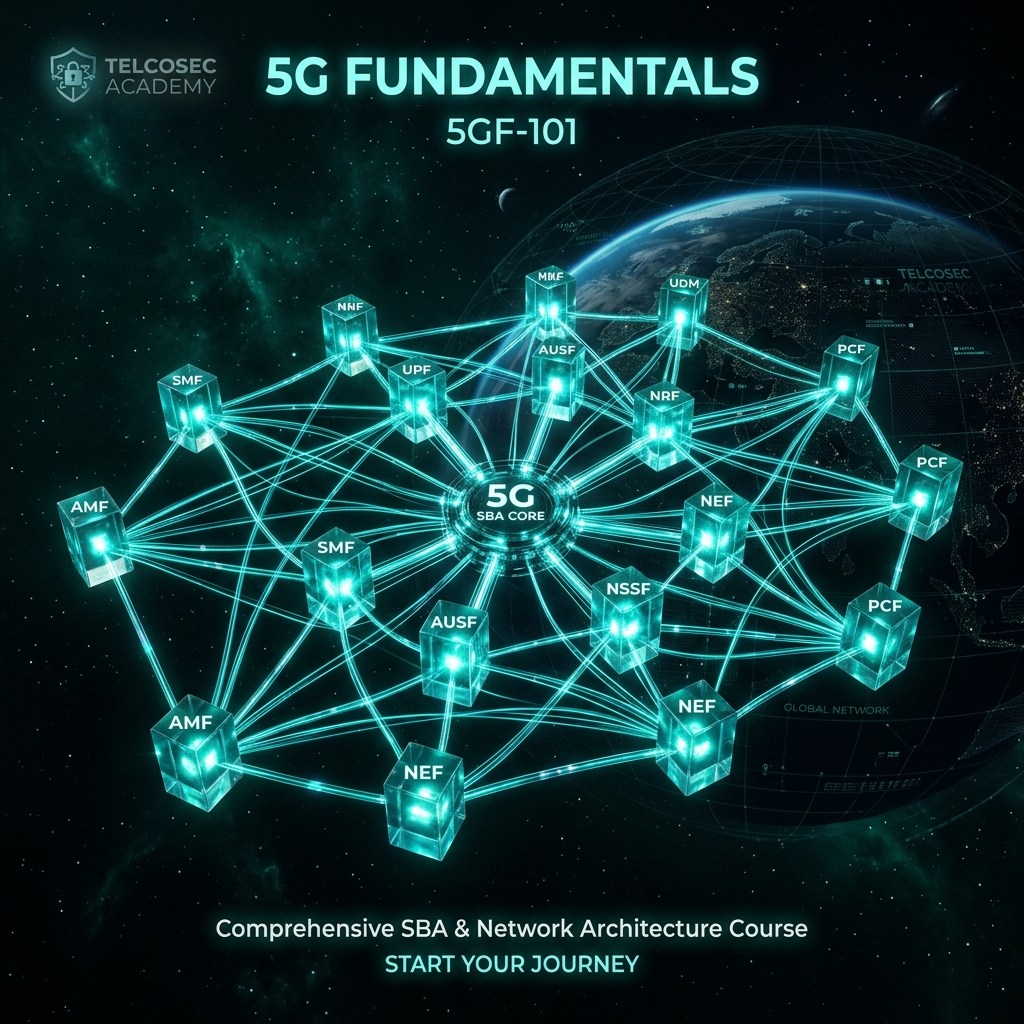
5G Fundamentals is the second and final course of the Mobile Network Analyst path, LTE then 5G, and is taken after LTE Fundamentals; passing the exams of both courses earns the Mobile Network Analyst certificate. It starts with what 5G is for: the ITU-R usage scenarios of enhanced mobile broadband, ultra-reliable and low-latency communications and massive machine-type communications, the 5G System of NG-RAN and 5G core with its standalone and non-standalone options, and Releases 15 and 16. It then follows the NR physical layer with its numerologies, frame structure, frequency ranges and bandwidth parts; initial access through the SS/PBCH block, beams and random access; and the NG-RAN, from the gNB and its central and distributed units to the NR protocol stack and SDAP. Later modules cover the 5G core and its service-based architecture with the AMF, SMF, UPF, AUSF, UDM, PCF, NRF and NSSF; registration, with the 5G identities and 5G AKA as a procedure; PDU sessions and QoS flows, from 5QI to UPF selection and PFCP; and connection and mobility management, from RM and CM states and RRC_INACTIVE to handover and interworking with the EPC over N26. The last modules cover network slicing and edge computing, and roaming, non-terrestrial networks and what comes next. The course ends with an interactive review, "SA registration to first PDU session".
>>> Clearance required
Unlock with Professional
This content is included with the Professional plan.
View plans5G Fundamentals Badge
Passing the final exam earns the 5G Network Engineer achievement and counts towards the TelcoSec Mobile Network Analyst certification, which needs the LTE Fundamentals and 5G Fundamentals final exams. It shows you can explain how 5G works from the NR physical layer and initial access to the NG-RAN, the service-based 5G core, registration, PDU sessions, slicing and roaming.