ADSL Fundamentals
How broadband reaches homes over the same copper telephone pair that carries a voice call. You will learn how the copper access network, DMT modulation, the DSLAM and PPP sessions work together to turn a telephone line into an always-on internet connection.
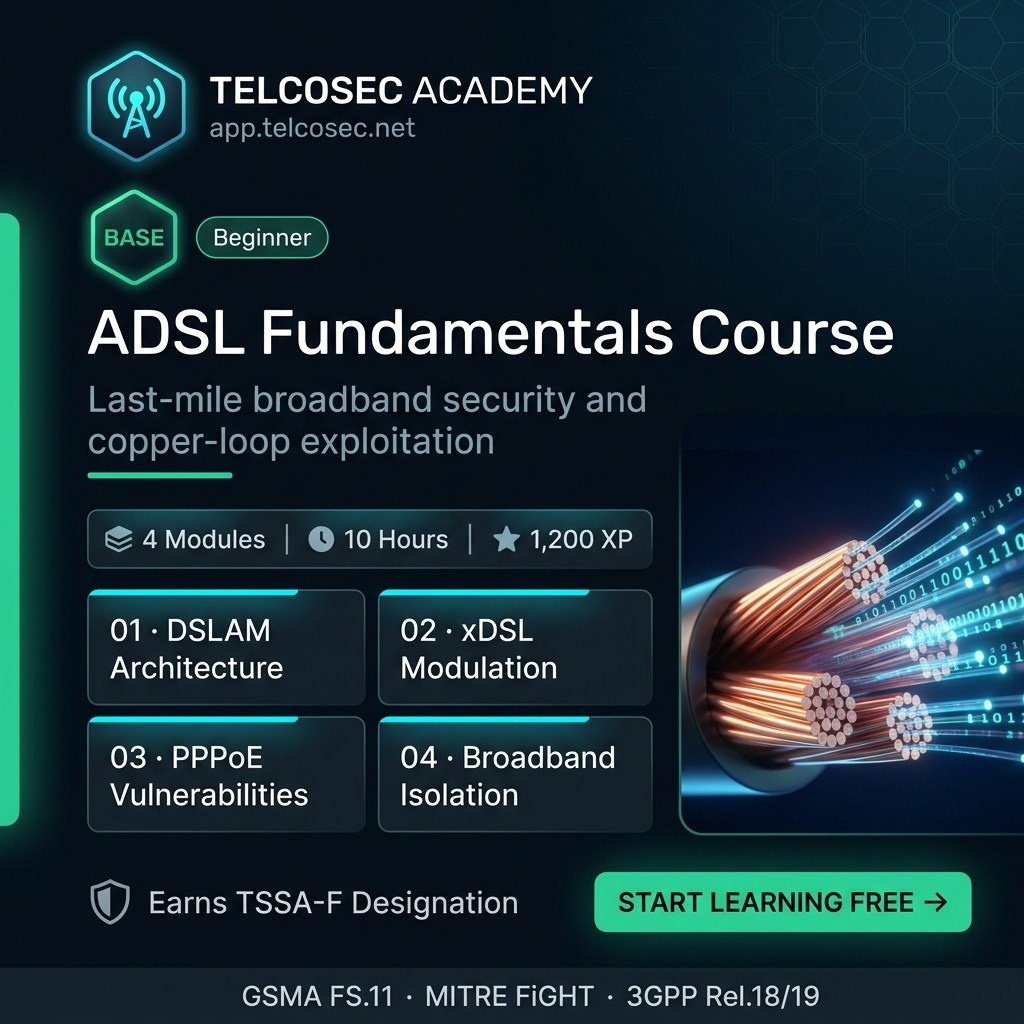
ADSL Fundamentals is the third course of the Telecom Foundations path and builds on Telecom Fundamentals and PSTN Fundamentals. It follows a digital subscriber line from the copper pair itself: the access network of cabinets, cables and gauges, how a pair behaves far above the voice band, discrete multitone modulation, the ADSL, ADSL2 and ADSL2+ standards and their band plans, splitters and filters in the home, line training and error protection, the DSLAM and its aggregation network, and the PPP sessions that give the customer an IP address. It then looks at VDSL2, vectoring and G.fast, and at how operators run DSL today alongside fibre and cable. The course ends with an interactive review, "Modem power-on to first web page", that follows a home router from switch-on to its first loaded page.
>>> Clearance required
Unlock with Professional
This content is included with the Professional plan.
View plansADSL Fundamentals Badge
Passing the final exam earns the DSL Access Engineer achievement and counts towards the TelcoSec Telecom Foundations certification, which needs the final exams of all five Foundations courses: Telecom, PSTN, ADSL, GSM and SIM Cards Fundamentals. It shows you can explain how a copper telephone pair becomes an always-on broadband connection, from DMT modulation and band plans to the DSLAM, aggregation and PPP sessions.