GSM-201Level Intermediate
COURSES

GSM Architecture

How a GSM network is engineered beneath the block diagram: the interfaces and their protocol stacks, the signalling that crosses them, and the procedures each network element runs. A message-level follow-on from GSM Fundamentals for engineers who need to read traces, specifications and operator designs.
CLR-02 REQUIRED You can read every lesson in this course, but quizzes and lesson completion unlock at 1500 XP — you currently have 0 XP.
TelcoSec Academy
GSM Security Analyst
GSM-201
GSM2GArchitectureProtocol stackInterfacesUmAbisA interfaceBSSAPSCCPMAPTCAPSS7GPRS
Overview

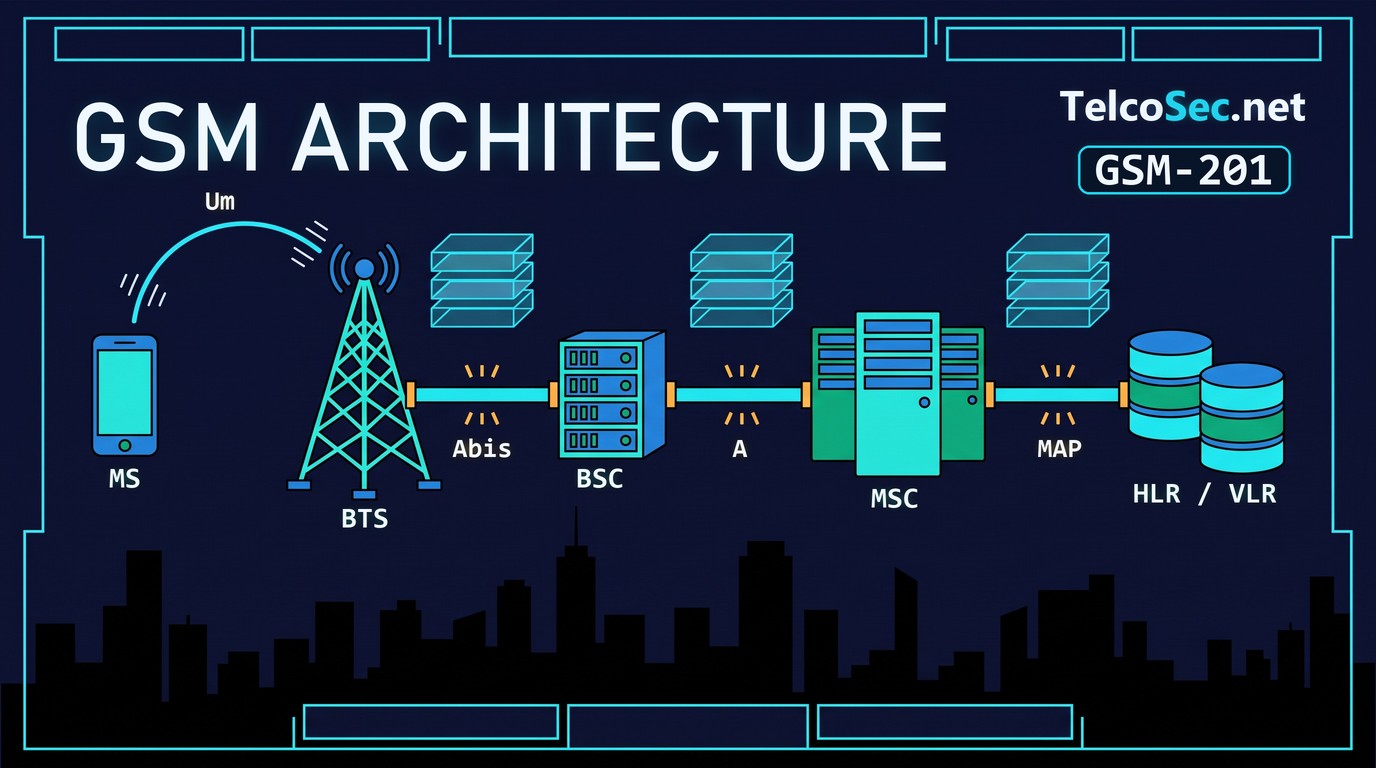
GSM Architecture goes deeper than GSM Fundamentals into how the network is built and how its parts talk. It opens with the architecture read as a protocol map: the lettered reference points of 3GPP TS 23.002, the protocol each carries, and why the functional split between the mobile station, base station subsystem and network and switching subsystem is drawn where it is. It then works through the air interface protocol stack and the Radio Resource procedures, the Abis and A interfaces with their LAPD and BSSAP layers, mobility and connection management at message level, the network core and the Mobile Application Part carried over the Transaction Capabilities Application Part and the Signalling System No. 7 stack, roaming and the home and visitor location register dialogue, the GPRS packet domain with its Gb, Gn and Gp interfaces, and dimensioning and real operator deployments. The course ends with an interactive signalling walkthrough of one end-to-end procedure across the Um, Abis, A and core interfaces.

Learning Objectives
Read the GSM reference architecture as a protocol map: name the lettered interfaces of 3GPP TS 23.002 and the protocol each carries, and explain why the functional split is drawn where it is
Follow the air interface protocol stack and the Radio Resource procedures at message level, from channel request and assignment to measurement reporting and ciphering mode
Describe the Abis and A interfaces, including LAPD, the Radio Signalling Link and Operation and Maintenance Link, and BSSAP split into BSSMAP and DTAP over SCCP
Explain Mobility Management and Connection Management procedures at message level, including location updating, TMSI reallocation and transaction identifiers
Describe the network core and the Mobile Application Part over TCAP, including the operations used for location update, authentication retrieval and subscriber data
Trace roaming and the home and visitor location register dialogue, and the GPRS packet domain across the Gb, Gn and Gp interfaces
Dimension base station controllers and switching centres and read a real operator topology, including transcoding and interworking to later generations
Prerequisites
GSM Fundamentals

>>> Clearance required

Unlock with Professional

This content is included with the Professional plan.

View plans
Career Outcomes
01Read GSM signalling traces across the Um, Abis, A and core interfaces and map them to the reference architecture
02Interpret 3GPP and ETSI GSM specifications to answer engineering questions about procedures and messages
03Explain how BSSAP, MAP and the SS7 stack carry GSM signalling, and dimension BSC and MSC capacity
04Enter the SS7, LTE and 5G courses with the message-level mobile-network grounding they assume
GSM Architecture Badge
Completion Badge

GSM Architecture Badge

Passing the final exam earns the GSM Network Architect achievement. It shows you can read the GSM reference architecture as a protocol map, follow its procedures at message level across the Um, Abis, A and core interfaces, and reason about how BSSAP, MAP and the Signalling System No. 7 stack carry GSM signalling.

RequiredThe achievement is awarded for passing the GSM Architecture final exam: 75 questions drawn from a bank of 150, with 70% needed to pass. Attempts are unlimited, with a 7-day wait between attempts. The module quizzes are practice and do not award the achievement on their own.