SS7 Fundamentals
How the common channel signalling network that sets up calls and carries database and mobility dialogues is built, layered and interconnected. You will learn how SS7/C7 moves messages reliably between exchanges, databases and mobile network nodes, from the signalling link up to ISUP, SCCP, TCAP, MAP and SIGTRAN.
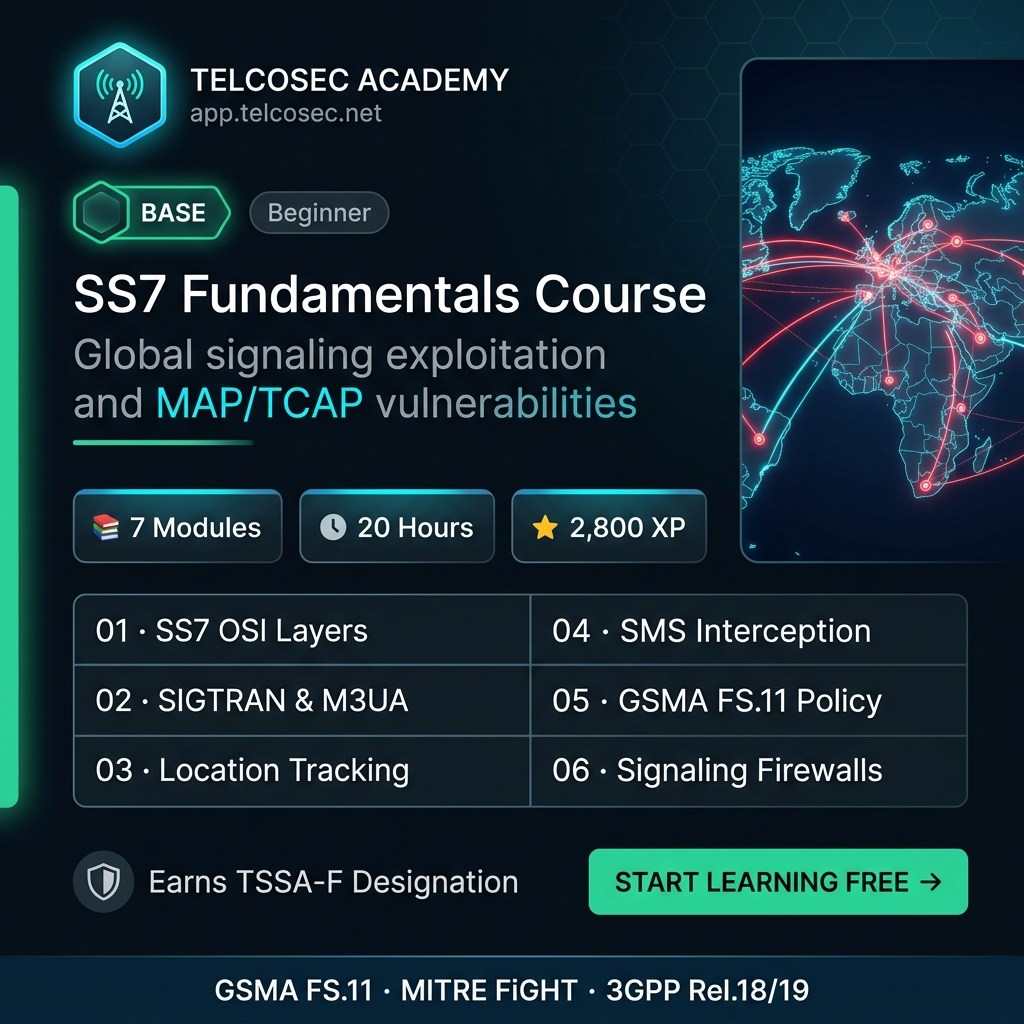
SS7 Fundamentals is the first course of the Telecom Signaling Analyst path and builds on the Telecom Foundations path, where PSTN Fundamentals and GSM Fundamentals introduced SS7/C7. It starts with why operators built a separate common channel signalling network, how the ITU-T Q.700 series defines it and what performance it was designed to meet. It then follows the network architecture of signalling points, transfer points, link sets and national and international networks, the message transfer part from the signalling link through error correction and alignment to routing, load sharing and network management, and the ISDN User Part that sets up and releases trunk calls. Later modules cover the SCCP with its global titles and global title translation, TCAP transactions, dialogues and ASN.1 encoding, the MAP dialogues of mobility, calls and short messages, and INAP, CAMEL and number portability. The last module carries SS7/C7 over IP with SCTP and the SIGTRAN adaptation layers and looks at international signalling carriers, IPX and the move to Diameter. The course ends with an interactive review that follows an international call's signalling from IAM to release, plus a short message delivered over MAP.
>>> Clearance required
Unlock with Professional
This content is included with the Professional plan.
View plansSS7 Fundamentals Badge
Passing the final exam earns the SS7 Signalling Engineer achievement and counts towards the TelcoSec Telecom Signaling Analyst certification, which needs the SS7 Fundamentals and SIP Fundamentals final exams. It shows you can explain how the SS7/C7 network is built, layered and interconnected, from MTP and ISUP through SCCP, TCAP and MAP to SIGTRAN.